
























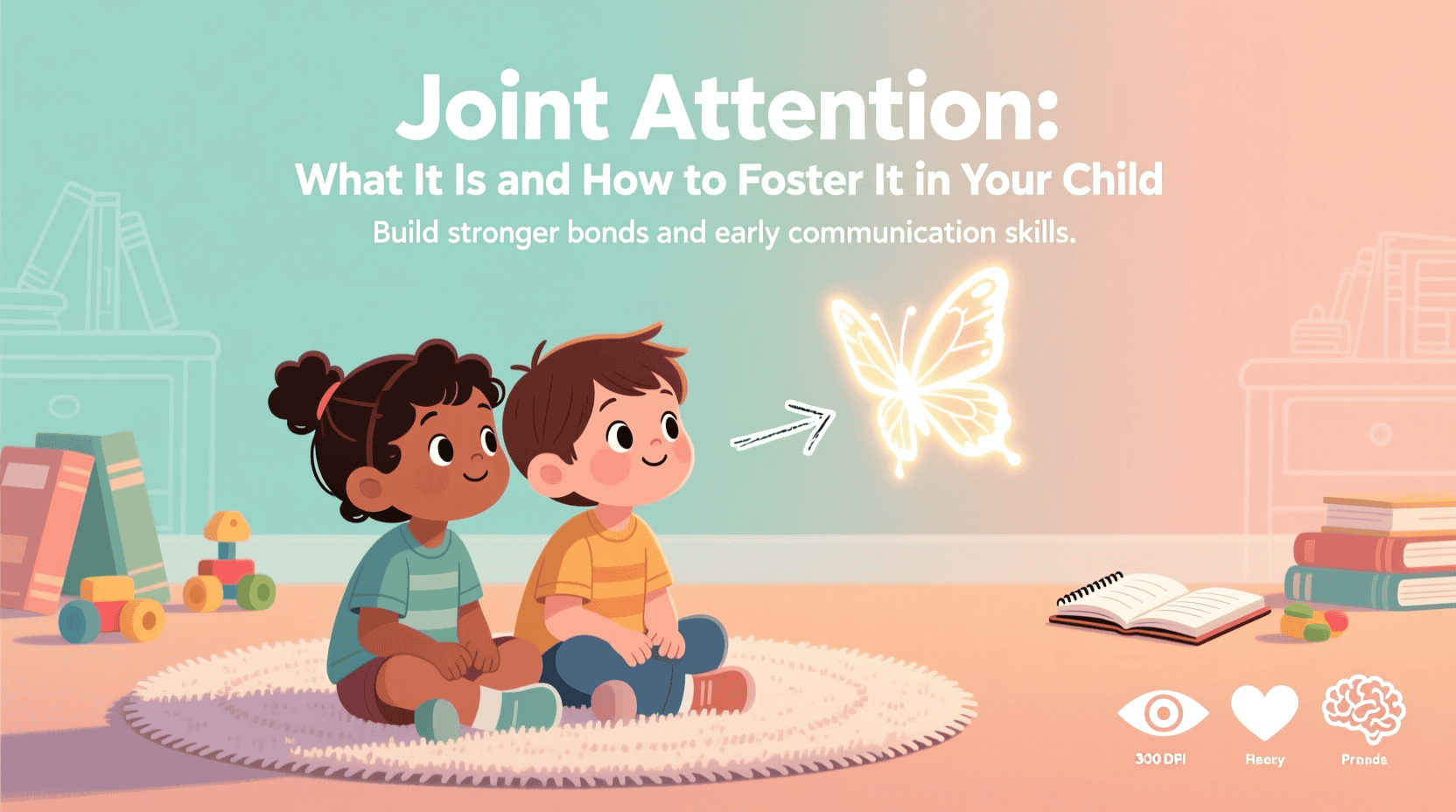
Children learn best through connection with people, with their environment, and with shared experiences. One of the earliest and most important forms of connection is joint attention, a foundational skill that supports communication, learning, and social interaction.
Joint attention might sound like a technical term, but it refers to something simple and deeply human: sharing focus on an object or event with another person. When a baby looks at a toy, then looks back at a parent to share the experience, they’re demonstrating joint attention. It’s how children learn to communicate, take turns, and build relationships.
For children with developmental delays or autism spectrum disorder (ASD), joint attention doesn’t always develop naturally. However, with structured guidance, consistent practice, and positive reinforcement, this vital skill can be taught and strengthened.
In this article, we’ll explore what joint attention is, why it’s critical for development, and how caregivers and professionals such as those at Kids Club ABA help children build this essential bridge to communication and learning.
Understanding Joint Attention
At its core, joint attention is about shared focus and mutual engagement. It involves two people paying attention to the same thing and acknowledging that they’re both attending to it.
For example:
- A parent points to a bird in the sky, and the child looks up to see it.
- A child holds up a toy to show it to a caregiver.
- A therapist looks at a puzzle piece, and the child follows their gaze.
These moments seem small, but they represent the foundation of human communication. Joint attention allows children to understand that others have thoughts, feelings, and perspectives separate from their own. It’s a cornerstone of social and cognitive development.
Two Types of Joint Attention
Joint attention involves two main components:
- Responding to Joint Attention (RJA):
This happens when a child follows another person’s gesture, gaze, or verbal cue to focus on something.
Example: A parent says, “Look at the dog!” and the child looks at the dog. - Initiating Joint Attention (IJA):
This occurs when a child directs another person’s attention to share an experience.
Example: A child points to an airplane and looks at the parent to share excitement.
Both responding and initiating joint attention are crucial for developing language, play, and social understanding.
Why Joint Attention Matters
Joint attention may seem like a simple act, but it’s one of the first indicators of social communication and cognitive growth. Research shows that joint attention predicts later language skills, emotional development, and even academic readiness.
1. Foundation for Language Development
Before children learn words, they must first learn that communication is about sharing experiences. Joint attention teaches that principle. When a child and adult both focus on the same object, the child begins to associate words with objects and events.
For instance, when a caregiver says, “Ball!” while both are looking at a ball, the child connects the sound of the word with the object itself. Over time, this process fuels vocabulary growth and comprehension.
2. Supports Social Interaction
Joint attention is the basis for social reciprocity taking turns, showing interest, and responding to others. It teaches children that communication is not one-sided but shared. This mutual awareness lays the groundwork for friendship, empathy, and collaboration.
3. Encourages Cognitive Development
Joint attention is closely linked to executive functioning and learning readiness. By following another’s gaze or gestures, children learn to process visual information, regulate attention, and interpret social cues.
4. Builds Emotional Connections
When a parent and child share attention, they also share emotions: delight, surprise, curiosity. These moments foster bonding and trust. The more a child experiences this shared engagement, the more naturally they seek it out in the future.
Challenges in Developing Joint Attention
Children with autism or developmental delays often find joint attention challenging. They may have difficulty:
- Following another person’s gaze or pointing gesture.
- Looking back and forth between an object and a person.
- Sharing interests or showing objects to others.
- Maintaining eye contact during play or interaction.
This difficulty doesn’t reflect a lack of interest or ability; it often stems from differences in how the child perceives and processes social information.
Early intervention programs, like those provided by Kids Club ABA, help children develop joint attention systematically, using evidence-based strategies that make learning engaging, rewarding, and personalized.
How ABA Therapy Teaches Joint Attention
Applied Behavior Analysis (ABA) therapy focuses on breaking down complex skills—like joint attention—into smaller, teachable steps. Therapists use structured methods to help children learn how to observe, respond, and initiate shared interactions.
Here’s how ABA typically approaches joint attention training:
1. Building Eye Contact
Therapists start with simple activities that encourage the child to look at another person’s face. For example:
- Playing peek-a-boo or “ready, set, go” games.
- Holding a preferred toy near the therapist’s eyes to encourage gaze shifts.
- Using songs or funny expressions to make eye contact rewarding.
Eye contact becomes the foundation for understanding that interaction involves mutual attention.
2. Teaching Response to Joint Attention (RJA)
Once a child is comfortable maintaining eye contact, the next step is following another’s attention cues.
The therapist might:
- Point to an object and say, “Look!”
- Use gaze shifting—looking at a toy and back at the child—to prompt imitation.
- Pair verbal cues (“Where’s the car?”) with gestures.
Each successful response is immediately reinforced with praise, smiles, or access to a favorite activity.
3. Encouraging Initiation of Joint Attention (IJA)
After the child learns to follow others’ cues, the focus shifts to initiating attention. The child learns to:
- Point to or hold up an object to share interest.
- Use eye contact and gestures to draw attention.
- Alternate gaze between an object and the therapist or caregiver.
This step nurtures social awareness and helps the child understand that communication is reciprocal.
4. Expanding Contexts and Complexity
As the child progresses, joint attention skills are practiced in more natural and varied settings: playtime, storytime, outdoor activities, or mealtime. The goal is to ensure generalization of the ability to use joint attention spontaneously across different people and environments.
Therapists gradually increase the complexity of tasks, introducing longer attention spans, varied objects, and multi-step interactions.
Strategies Parents Can Use at Home
Joint attention isn’t limited to therapy sessions; it can and should be nurtured throughout the day. Parents play a powerful role in reinforcing these skills at home.
Here are practical strategies caregivers can use:
1. Follow Your Child’s Lead
Join in your child’s current focus of interest instead of redirecting it. If your child is playing with blocks, sit down and build with them. By sharing their focus, you naturally create opportunities for joint attention.
2. Use Exaggerated Facial Expressions
Show enthusiasm and emotion with your face and voice. Animated expressions capture your child’s attention and encourage them to look at you.
3. Point and Label
Frequently point to objects, people, or pictures while naming them. Encourage your child to follow your gaze or finger. Use phrases like “Look!” or “Do you see that?”
4. Create “Give and Take” Games
Simple turn-taking activities—rolling a ball, passing a toy, or blowing bubbles—help build awareness of others and promote shared engagement.
5. Celebrate Shared Moments
When your child looks at something with you, smiles, cheers, or comments on it. Positive emotional feedback makes shared attention enjoyable and reinforces future attempts.
6. Use Imitation Games
Children often learn joint attention through imitation. Copy your child’s movements or sounds, then pause to let them copy you back. This exchange strengthens awareness of shared interaction.
7. Use Visual and Auditory Prompts
If your child doesn’t respond to pointing alone, combine gestures with sounds like tapping the object or calling their name. This multi-sensory approach helps capture attention.
Play Activities That Encourage Joint Attention
Play is one of the best ways to teach joint attention naturally. Fun, interactive games keep children motivated while reinforcing shared focus.
Some examples include:
- Bubble Play: Blow bubbles, then pause and wait for your child to look at you before blowing more.
- “Ready, Set, Go” Games: Stop before saying “Go!” to prompt your child to look at you for the cue.
- Peek-a-Boo: Encourages anticipation and shared engagement.
- Pretend Play: Using toy animals, cars, or kitchen sets allows children to share imaginative experiences.
- Reading Together: Point to pictures, ask questions, and wait for your child to look or respond.
Each of these activities strengthens the back-and-forth rhythm of communication—an essential element of joint attention.
The Role of Reinforcement in Teaching Joint Attention
Positive reinforcement is a core principle of ABA therapy and is vital for teaching joint attention. Children learn best when their efforts lead to meaningful rewards.
Reinforcement can include:
- Verbal praise (“Great looking!”)
- Clapping or cheering
- Access to a favorite toy
- Physical affection like a high-five
- Sensory rewards, such as spinning a top or bouncing a ball
Therapists at Kids Club ABA often individualize reinforcers based on what motivates each child most. This personalization ensures learning remains engaging, effective, and fun.
Common Barriers to Joint Attention and How to Overcome Them
Some children may resist joint attention efforts at first. Common barriers include:
- Limited motivation: The child may not yet see the value in shared experiences.
- Sensory sensitivities: Eye contact or proximity might feel uncomfortable.
- Difficulty shifting attention: The child may become fixated on objects.
- Language or comprehension challenges: The child may not understand verbal cues.
To overcome these barriers, therapists use a gradual, supportive approach—pairing preferred activities with social interaction, offering choices, and allowing the child to take the lead. Over time, shared attention becomes a positive, rewarding experience rather than a demand.
How Progress Is Measured
Joint attention development is carefully tracked in ABA programs. Therapists collect data on how often and independently the child responds to or initiates shared attention.
Progress indicators include:
- Frequency of gaze following.
- Number of spontaneous joint attention initiations.
- Ability to maintain attention during interaction.
- Responsiveness to pointing, gestures, and facial expressions.
Programs like those at Kids Club ABA use this data to adjust goals and ensure steady progress toward more complex social and communication milestones.
From Joint Attention to Communication
Joint attention is a stepping stone toward expressive and receptive language. Once children understand how to share focus, they begin to use words to describe what they see, request, and share emotions.
For example:
- A child learns to look where the parent points (joint attention).
- Next, the child begins to point independently to share interest.
- Eventually, the child adds the language“Look, airplane!” to express and share experiences verbally.
Without joint attention, these natural stages of communication can stall. By mastering this skill, children unlock the door to understanding others and expressing themselves effectively.
The Long-Term Impact of Joint Attention
Strong joint attention skills predict better outcomes in language, academics, and social relationships. Children who can share attention and experiences are more likely to:
- Engage successfully in classroom activities.
- Build friendships through shared interests.
- Develop empathy and emotional awareness.
- Learn independently through observation.
Joint attention helps children connect with others and with the world a critical foundation for lifelong learning and social success.
Conclusion
Joint attention is far more than a developmental milestone; it’s the bridge between awareness and interaction, between seeing and connecting. It’s how children learn that communication is about sharing the world with others.
For children with autism or developmental challenges, joint attention may require explicit teaching and consistent reinforcement. But with patience, practice, and support, it can flourish beautifully.
Programs like Kids Club ABA specialize in fostering these essential skills through structured, evidence-based methods that celebrate every small success. By focusing on joint attention, caregivers and therapists help children not just look but truly see together, learn together, and grow together.
Every shared glance, every pointed finger, and every joyful “Look!” is more than a simple act—it’s a step toward connection, understanding, and independence.