
























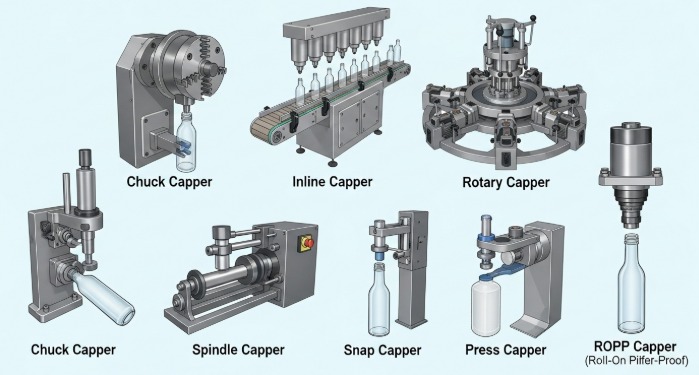
In the packaging industry, applying caps to containers isn’t just about sealing a product—it’s about ensuring safety, maintaining freshness, and presenting a polished appearance. This is where capping machinery plays a vital role. From food jars to cosmetic sprays, various types of caps are used in manufacturing, each requiring a specific type of capping solution.
In this guide, we’ll break down the most common types of capping machines based on the type of cap they’re designed to apply: screw caps, ROPP caps, press-on caps, and trigger or spray caps.
Screw Cap Capping Machines
Screw caps are among the most widely used closures in the packaging world. They are threaded caps that twist onto the container, commonly found on bottles of water, condiments, cleaning products, and other similar products.
To apply these efficiently and securely, screw cap capping machines utilise rotating components—such as chuck heads or spindle wheels—to apply consistent pressure to the caps onto the containers.
Key Features:
- Ideal for plastic or metal threaded caps
- Available in manual, semi-automatic, and fully automatic models
- Suitable for high-speed production lines
Screw capping machinery is a staple across industries, thanks to its versatility and ability to work with a wide range of container sizes and materials.
ROPP Capping Machines (Roll-On Pilfer-Proof)
ROPP (Roll-On Pilfer-Proof) caps are made from aluminium and are commonly used in industries that require tamper-evident sealing—such as wine, spirits, pharmaceuticals, and edible oils.
ROPP capping machines don’t screw the caps onto the container. Instead, they use specially designed rollers to form threads in the aluminium as the cap is applied to the bottle, creating a tight and secure seal.
Key Features:
- Designed specifically for aluminium caps
- Provides tamper-evident closures
- Often used with glass bottles
ROPP capping machinery is more specialised but essential for brands looking to protect product integrity and consumer safety.
Press-On Capping Machines
Press-on caps (also called snap-on caps) are closures that do not require threading. Instead, they are pressed directly onto the container until they snap into place. This type of cap is commonly used in dairy, snacks, pharmaceuticals, and personal care products.
Press-on capping machines apply downward pressure to affix the cap securely, either using pneumatic or mechanical force.
Key Features:
- Ideal for non-threaded plastic or metal caps
- Simple and reliable design
- Excellent for delicate containers
This type of capping machinery is great for operations that need a gentle yet firm application process without the need for twisting or torque.
Trigger and Spray Cap Capping Machines
Trigger and spray caps are common in products like household cleaners, hair products, and gardening sprays. These closures typically require precise orientation to ensure that the nozzle is facing the correct direction when the cap is fully tightened.
Capping machines for trigger and spray caps often include components to orient, place, and torque the caps correctly without damaging the trigger mechanism.
Key Features:
- Specialised handling for bulky and irregularly shaped caps
- Includes orientation systems for proper nozzle alignment
- Designed for more complex closures
Because trigger and spray caps are often used on tall or oddly shaped bottles, this type of capping machinery is engineered to handle more challenging packaging formats.
Choosing the Right Capping Machinery for Your Production Line
The type of capping machinery you need depends on several factors:
- Type of cap and container
- Volume of production
- Speed requirements
- Level of automation desired
- Industry standards or regulatory requirements
Understanding the differences between screw, ROPP, press-on, and spray caps will help you make the right investment in machinery that enhances efficiency and ensures consistent sealing.
Conclusion
From threaded screw tops to tamper-proof aluminium closures and precise spray cap applications, capping machines are essential to modern production lines. Each type of cap requires a unique approach—and the right capping machinery ensures your packaging is secure, compliant, and customer-ready.
Whether you’re scaling up production or automating for the first time, selecting the right capping equipment can save time, reduce product loss, and elevate your brand’s professionalism.