




















Should you script your business video or just freestyle it?
It’s a difficult choice. Don’t worry, it’s not a big deal… except that it can make or break your entire video, including how well you connect with your viewers.
At Grizzly Bear Media, we help businesses make this exact decision every day. So in this guide, we’ll cover when you’ll need scripted videos, and when going with unscripted videos will be a better choice. We’ll also explain how to select the right video format depending on what you want from your video.
Ready to find out what works for your next project? Let’s get started.
The Value of a Refined Video Script
Having a refined video script gives you more control and clarity, which will improve your content delivery, audience engagement, and overall production quality. Think of the script as a blueprint that ensures your video hits its main objectives (good videos don’t happen by accident).
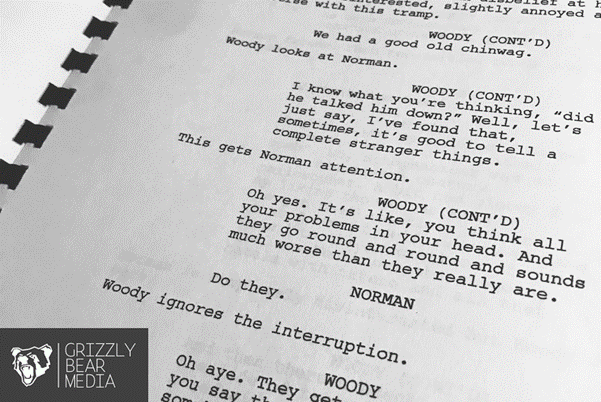
Now, you get three major benefits from refined video scripts: consistent messaging, better efficiency on filming day, and reduced costs through fewer retakes.
We’ll talk about these benefits now in detail.
Guaranteeing Consistent Messaging
When you use scripts, you deliver your primary corporate message accurately and uniformly to audiences. It’s because product explanations and formal announcements leave no room for error.
Consider a software company announcing a security update. Without a script, the presenter might forget compatibility requirements or skip installation steps. But with a script, you have every technical detail in the right order.
Your legal team can also approve the exact wording beforehand. Every word is important in any business.
Improving Production Day and Cost Efficiency
Here’s the thing: a script saves time and resources during filming. It’s that simple. Your presenter receives clear direction, and your crew knows exactly what to capture. And scripted shoots typically finish faster than unscripted ones.
Recently, we handled two client testimonial shoots. The scripted version took two hours and three takes, while the unscripted one ran four hours with multiple restarts. The presenter kept circling back to the same points and forgetting others entirely.
Frustrating, yes, but that’s how it went.
The Power of Unscripted Videos
Now let’s talk about the flip side of scripted videos. Audiences today crave real conversations over polished perfection. For this reason, unscripted videos offer a way to build human connections that scripted content sometimes struggles to achieve.

With these unrehearsed and relatable unscripted videos, you get actual reactions and honest conversations. It creates something special for your audience, which also leads to building trust faster.
Three reasons why you should go with unscripted videos:
- Building Trust: Your viewers connect more with unscripted content because people sense honesty in sincere testimonials. E.g., a customer sharing their experience without preparation sounds enthusiastic and authentic. You can’t replicate those natural pauses, smiles, and unpolished moments with scripted videos.
- Showcasing Personality: Behind-the-scenes footage lets your business character come through in ways scripts never could. Watch what happens when your team speaks spontaneously. The memorable qualities of quirks, humour, and passion suddenly appear.
- Speed and Relevance: If you need to respond to breaking news or trending topics, unscripted videos can go live within hours. No writing phase, no approval process, no rehearsal time. Your camera captures the moment while it’s still valuable to your audience.
The Hybrid Method for Talking Heads
Here’s the thing about talking heads… You don’t have to choose strictly one or the other. Good talking head videos combine preparation with improvisation, and this middle-ground strategy gives you structure without sounding robotic.
Hybrid methods work best for most business videos, too. You get the reliability of preparation plus the warmth of natural conversation. The result? Videos that feel planned but are nowhere near stiff.
You can use two hybrid methods for your work, and here they are.
Using a Bullet-Point Framework
The bullet-point framework has become a popular hybrid technique among video creators. Instead of memorising exact words, speakers work from important points that guide their conversation.
The structure comes from the speaker following important talking points and ensuring they have covered all critical information. No important details slip through the cracks during filming.
And the best part is, the exact wording for the video stays with the speaker. It allows their natural delivery and personality to come through as well. In these kinds of videos, conversations flow more naturally than scripted readings. No one wants corporate-robot vibes.
Scripting Only Critical Segments
There’s another hybrid method that focuses on scripting the important parts while leaving room for natural conversation elsewhere. Here, you script only the video’s introduction and conclusion to ensure a strong start and a clear call-to-action. It’s because these moments are important for viewer retention.
For the central part of the video, this approach lets everything flow more freely and conversationally. Speakers get the complete freedom to elaborate on resonating points or skip unnecessary details easily.
Applying the Format to Your Target Audience
Sometimes people misunderstand it, but different audiences expect different levels of formality from your content. Think about it this way: corporate training videos need various treatments that behind-the-scenes Instagram stories don’t require.
Now let’s break down where each format works best.
For an Internal Corporate Message
Internal audiences often require clear and direct information. Your employees need facts instead of entertainment.
Imagine a formal training session covering new safety procedures. In situations like these, a full script works best. Complex procedures or compliance information can’t afford mistakes or confusion. So, your team needs consistent, accurate information every time (the one time where “robotic” is actually a good thing).
However, leadership updates work differently. A hybrid bullet-point method projects confidence and clarity without sounding overly rehearsed. At the same time, executives can hit their main points while they maintain their natural communication style.
You have to understand these differences to figure out which format is the best for your corporate messages.
For External Social Media Platforms
Public-facing channels demand different treatment from internal communications. The reason is simple: each platform has its own culture and expectations.
Consider LinkedIn’s professional atmosphere. In this environment, a hybrid format works well for business content. Your audience expects refined but personal communication from you.
Instagram and TikTok tell a different story, though. On these platforms, purely unscripted videos feel more native and perform better. It’s because users scroll quickly and stop for content that feels real and spontaneous.
Finding Your Video’s Voice
This script versus unscripted debate used to keep us up at night, too. After 30+ years of making videos (and quite a few spectacular failures), we’ve learned there’s no specific formula.
We’ve shown you how scripts guarantee consistency and efficiency, how unscripted content builds trust and showcases personality, and why hybrid methods work brilliantly for talking heads.
Each approach has its place depending on your audience and platform, and every video tells you what it wants to be. Corporate safety training? It’s screaming for a script. Behind-the-scenes Instagram story? Keep it natural. You’ll know when you’ve got it right because it’ll feel like… well, like you.
Want to talk about your next video? Contact us today at Grizzly Bear Media and let’s have a chat.