






















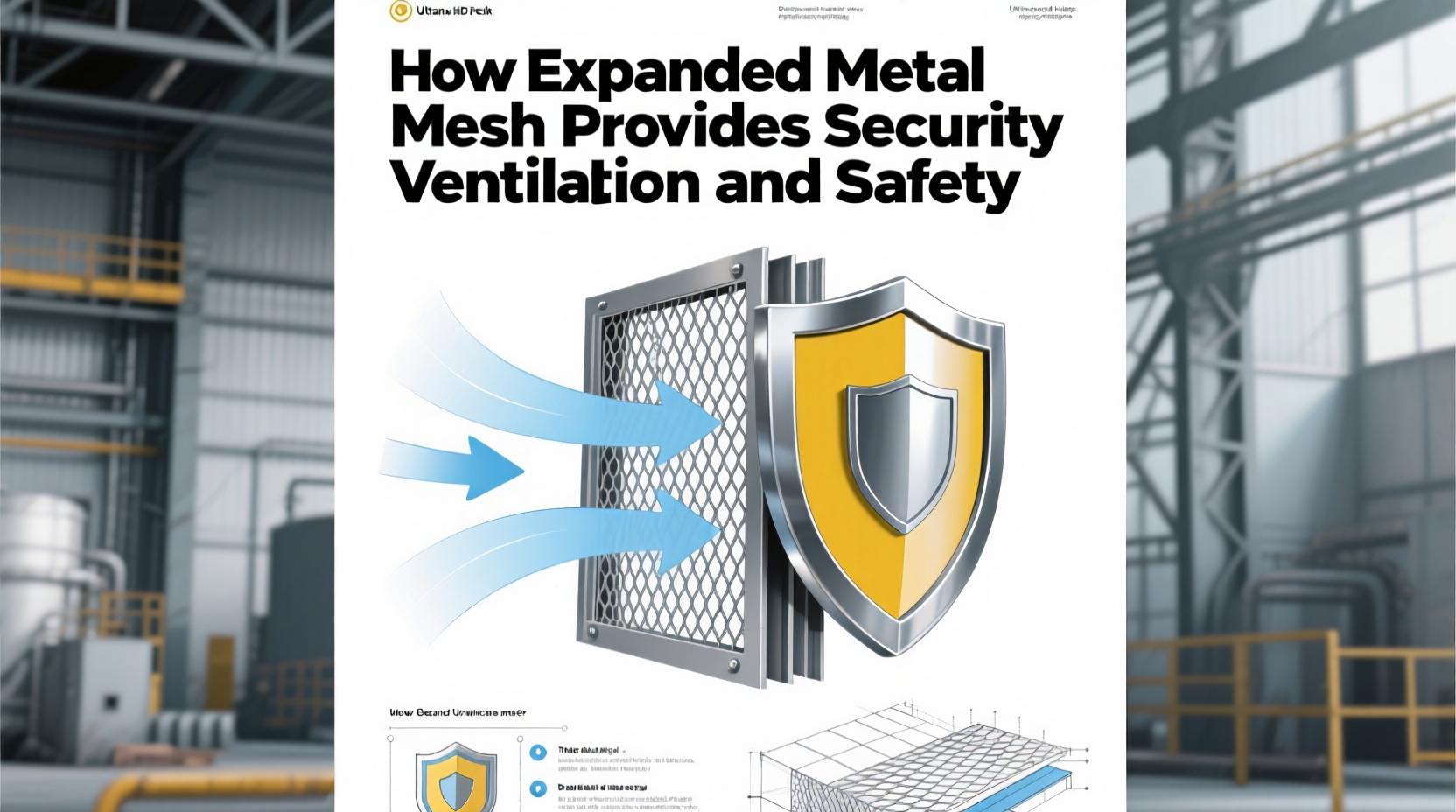
Imagine a material so versatile it can protect maximum-security prisons, dissipate the heat of industrial furnaces, and provide non-slip grip on rainy days. It’s not a futuristic polymer or a complex electronic system, but something more elegant and simple, the product of ingenious manufacturing engineering: expanded metal mesh. It’s no ordinary wire mesh; instead, it’s shaped, stretched, and cut into a diamond-shaped grid that offers incredible strength and functionality. It’s an unsung hero in the construction and industrial sectors, delivering three key benefits: safety, ventilation, and protection—often simultaneously. Its story begins not with weaving but with expansion, a process that gives it its unique superpowers.

The magic of expanded metal mesh lies in its manufacturing process. Unlike woven wire mesh, which consists of interwoven individual wires, expanded metal mesh begins as a single, solid sheet of steel, aluminum, stainless steel, and more. The metal sheet is fed into a large, powerful machine that simultaneously cuts the sheet in a staggered pattern and then stretches it. This process stretches the metal sheet, creating a uniform pattern of cutouts. This isn’t simply punching holes in the metal, which creates waste material (the small, punched-out pieces, called “skeleton”). It’s a redistribution process. Metal isn’t removed; it’s simply rearranged and stretched into a tightly bound, one-piece mesh. This process creates an exceptionally strong mesh because each wire is firmly connected to the next; there are no weak points from welding or weaving. The integrity of the original metal sheet is preserved, simply taking on a new, open form. This fundamental process gives the mesh its legendary durability and distinctive diamond-shaped character. When you think of security, you might picture thick steel plates or imposing concrete walls. But true security doesn’t usually mean building an impenetrable barrier; it’s about creating a fence that’s both aesthetically pleasing and psychologically intimidating, while also balancing visibility and good airflow. This is where expanded metal mesh truly becomes a security superstar. While a solid wall is strong, it also has hidden dangers, creating hidden corners and a sense of claustrophobia. While traditional fencing offers high visibility, its wires are relatively easy to cut. Expanded metal mesh cleverly solves both problems. Its interconnected wires make it extremely difficult to penetrate. You can’t simply cut a few wires to create a hole; the entire mesh is a single, resilient entity. Attempting to cut or pry it open requires considerable time, strength, and the use of noisy tools—the exact opposite of what a potential intruder wants.
Expanded metal mesh also offers a powerful psychological deterrent. The rugged, industrial look of heavy-duty expanded metal mesh sends a clear and unmistakable message: “This area is protected.” It looks strong because it is. This makes it ideal for a variety of uses, from fencing and window grilles on fragile buildings to security fencing for valuable equipment and warehouse partitions. However, unlike physical barriers, it doesn’t create dark, isolated spaces. Security personnel have an unobstructed view of the protected area. Those within don’t feel like they’re in a dungeon; natural light can still filter through. It offers security without creating a sense of isolation or oppression. Furthermore, the open structure allows for vital ventilation, preventing the buildup of heat, steam, or moisture—critical for extending the lifespan of the protected object. Therefore, expanded metal security systems are intelligent, offering multi-layered protection that blends physical defense, psychological deterrence, and practical functionality.
Let’s delve deeper into the concept of “see-but-don’t-touch.” Expanded metal’s design is a masterpiece of controlled permeability. The size and shape of the openings can be precisely adjusted during the manufacturing process. For high-security applications, the wire strands can be made thicker and the openings smaller, creating a mesh that allows only air and light to pass through, but absolutely no hands or tools. For other applications, the openings can be larger. This adaptability is a huge advantage. Imagine a bus stop or a ticket counter. Cashiers need the protection of a security barrier, but they also need to be able to communicate with customers and potentially exchange small items like tickets and cash. A solid wall with only a small window can feel isolating and inefficient. However, a metal mesh can be installed that allows for clear conversations and easy passage of small items, while also forming a strong physical barrier between employees and the public. It facilitates necessary interactions while completely preventing unnecessary physical contact. This principle also applies to machine guards in factories, where operators need to observe the equipment in action while avoiding contact with moving parts; and to animal enclosures, where keepers need to safely observe and interact with the animals. Metal mesh acts like a transparent wall, redefining the line between what’s allowed and what’s not.

Now let’s turn to breathability. It might seem counterintuitive that a material renowned for its strength and safety should also be a pioneer in ventilation, but that’s precisely the wonderful duality of metal mesh. The same network of openings not only provides excellent visibility but also creates perfect channels for air circulation. Stagnant air is a problem in any enclosed space. It can lead to heat buildup, condensation, the accumulation of dangerous fumes, or simply an unpleasant, stuffy environment. Solid barriers can exacerbate these problems.However, metal mesh offers a perfect solution, acting as the structural lungs of a building or machine. It allows for continuous air exchange, letting warm air escape and cool, fresh air circulate, while maintaining its primary function as a barrier.
This makes it indispensable in the industrial sector. Anyone walking through a factory will see metal mesh everywhere. It’s used as building cladding to dissipate heat generated by machinery. It also serves as a barrier around chemical storage facilities, where dangerous vapors must be vented to prevent explosive concentrations. It forms the walls of outdoor generator enclosures, allowing large engines to “breathe” and absorb cool air for combustion while dissipating waste heat. This passive ventilation is crucial to preventing overheating and equipment failure. Without it, expensive active cooling systems would have to bear greater strain, driving up energy costs. Expanded metal offers a simple, elegant, and maintenance-free way to regulate thermal dynamics and air quality, proving that robustness and openness are not mutually exclusive.
This ventilation capability extends far beyond the factory floor. Architects value expanded metal for its adaptability to the dynamic facades of modern buildings. Large mesh panels can be used as sunshades or cladding, blocking intense sunlight and thus reducing cooling costs within buildings. At the same time, their open structure allows for air circulation, preventing the building from feeling completely enclosed. Expanded metal creates a constantly changing pattern of light and shadow, adding aesthetic texture and depth to building facades. It is used in front of interior heating and air conditioning systems, protecting them from damage while still allowing for vital airflow. In parking lots, it acts as perimeter protection, demarcating safe spaces while allowing air to pass through, helping to dissipate vehicle exhaust. Metal mesh strikes a challenging balance: it creates a physical boundary while cleverly promoting airflow for health, comfort, and efficiency.
Beyond keeping intruders out and allowing air to circulate, metal mesh also provides essential protection for everyday safety. Thanks to its unique design, it effectively prevents accidents and injuries. First and foremost, it offers anti-slip properties. The metal mesh is stretched to create a textured surface. The raised wire mesh and diamond pattern provide excellent grip even in wet, oily, or muddy conditions. For this reason, metal mesh is often used for industrial floors, walkways, ramps, and stairways in factories, ships, offshore platforms, and fire escapes. In these environments, slippery surfaces are not only uncomfortable but can be life-threatening. The support provided by metal mesh ensures workers take every step safely and significantly reduces the risk of slips and falls.
Secondly, its strength and rigidity make it ideal for machine guarding. Every rotating machine in a factory—from conveyor belts to large gearboxes—presents a potential hazard. The U.S. Occupational Safety and Health Administration (OSHA) and other safety regulations around the world require shielding these hazards to protect workers. Expanded metal is the ideal material for these guards. It can be fashioned into cages and boxes to completely enclose hazardous equipment. A key advantage of expanded metal over solid metal components is visibility. Workers can clearly see through the guards into the machine and monitor for signs of malfunction or jamming without touching the moving parts. Expanded metal acts as a transparent barrier, blocking flying debris and preventing accidental contact, ensuring safety. This doesn’t come at the expense of operator awareness. Expanded metal applications provide silent, long-lasting protection, saving countless fingers and lives.
Expanded metal’s safety story continues in more subtle ways. Due to its durability, it doesn’t tear, shatter, or degrade easily under UV rays or inclement weather, unlike some plastics or wood. It’s used in public spaces. This long-term structural integrity is a safety feature in itself; you can be confident that a railing or platform made from galvanized expanded metal will remain stable for decades to come. Furthermore, in applications such as balcony railings or highway guardrails, the open structure minimizes wind loads. A solid wall, like a sail in strong winds, exerts immense pressure on its supporting structure. Expanded metal, however, allows wind to pass through, reducing this pressure and making the entire structure more stable and safe in inclement weather. This material addresses safety from every angle—from the grip under your boots to the stability of the structure itself.
It’s important to note that these three key advantages—safety, ventilation, and protection—are not mutually exclusive. They are often combined in a single, excellent expanded metal application. Imagine a utility substation. It requires a high level of security to prevent vandalism and unauthorized access, which could disrupt power supply to thousands of people. Ventilation is needed to dissipate the enormous heat generated by the transformers and electrical equipment to prevent fires and equipment failures. Furthermore, safety precautions are required to protect authorized personnel within the building and prevent the public from accidentally touching live parts. A single layer of heavy-duty galvanized expanded steel achieves all three of these goals. It’s a safety fence, ventilation wall, and protective barrier all in one.
Or imagine a loading dock door. If it’s left open, the loading dock is at risk. A security door made of metal mesh rolls down. It protects the opening from intruders, allows warehouse staff to see inside, allows air to circulate (especially important for forklifts), and provides a secure, transparent barrier to prevent workers from accidentally leaving the dock. In architecture, decorative metal mesh on a building’s exterior provides shade (from direct sunlight), protects windows behind it, and allows ventilation. This synergy is the hallmark of a truly exceptional material. It doesn’t force you to choose between safety and comfort, security and visibility. It meets all your needs.
From its humble beginnings as a solid sheet of metal to its ultimate form as a resilient open weave, metal mesh is a testament to simple yet remarkable engineering. It defies simple categorization. It’s strong yet open, imposing yet transparent—like a barrier that breathes. It provides solid security in prisons, vital ventilation in factories, and crucial safety for workers working at height on oil platforms. It’s a presence in the cities we live in and in the industries that power our lives, working silently and unobtrusively. So, the next time you climb a metal staircase, glance at a security fence, or feel a breeze in a seemingly enclosed space, take a closer look. You’re likely witnessing the magic of expanded metal, a humble material that makes it all possible.