A good heat pump project starts with the house, not the equipment catalogue. Before comparing models, ask how the installer will measure heat loss, assess radiators and plan hot-water demand. That groundwork explains the real air source heat pump installation cost and prevents an attractive headline price from becoming an underperforming system. A heat pump can deliver steady, comfortable heating in a British winter, but only when its output, controls and emitters work as one design.
An air source heat pump takes low-temperature heat from outside air and upgrades it for space heating and hot water. It does not behave like a boiler that fires hard for short periods. Most systems are happiest running for longer at a lower flow temperature. That difference is why the quality of the survey matters. A competent designer needs room dimensions, fabric details, glazing, ventilation assumptions and the design temperature for the area. Guessing from floor area alone is not enough.
The survey should also look at the proposed outdoor-unit position. There must be sensible airflow, access for servicing, a stable base and a route for condensate. Indoors, the installer checks the cylinder, pipework, electrical supply and controls. Some radiators may already be suitable; others may need a larger surface area. It is perfectly reasonable to ask for the room-by-room calculations and an explanation of any recommended changes.
Air Source Heat Pump Installation Cost: What Shapes the Quote
The price is not simply the cost of the outdoor unit. A complete air source heat pump installation may include heat-loss calculations, system design, a hot-water cylinder, radiator upgrades, electrical work, pipework, controls, commissioning and removal of the old heating appliance. Access can also change the labour requirement. A compact modern home with straightforward pipe routes is a different project from a large period property with several heating zones.
Look closely at what a quotation includes. Does it cover scaffolding or lifting equipment if required? Are radiator changes itemised? Who handles the electrical work, commissioning documents and warranty registration? Is aftercare included? Two quotes can differ substantially because one describes a complete handover while the other leaves essential work as an allowance.
Government support may reduce the amount an eligible homeowner pays. In England and Wales, the Boiler Upgrade Scheme currently provides support for qualifying heat-pump projects, with the level depending on the technology and circumstances. Eligible off-gas properties replacing oil or LPG may qualify for a higher contribution than the standard air-to-water grant. The installer normally applies on the owner’s behalf. Scheme rules can change, so eligibility and the value shown in a quote should be confirmed against current Ofgem or GOV.UK guidance rather than assumed.
Running cost needs its own conversation. It depends on the building’s heat demand, electricity tariff, system efficiency and how the controls are used. A promise that one product will cut every household’s bill by the same percentage is not credible. Ask for the estimated annual heat demand, the design flow temperature and the seasonal performance assumption behind any forecast. Those figures allow a meaningful comparison.
Air Source Heat Pump Installation Near Me: Why Local Knowledge Matters
Searching for air source heat pump installation near me is useful when it leads to a team that understands local housing, weather exposure and service access. It should not be the only test. Check whether the installer is MCS certified for the relevant technology, carries appropriate insurance and can show completed projects similar to your property. If a grant is involved, MCS certification is especially important because the application is installer-led.
Local evidence is more valuable than a gallery of anonymous equipment. Ask to see a recent project in a comparable house. A 1930s semi, rural stone cottage and new-build terrace rarely need the same design choices. Useful case studies describe the original heating system, design challenge, emitter changes and result. They do not merely show a photograph of the outdoor unit.
Availability after installation also matters. Controls take a little getting used to, and questions often arise after the first cold spell. Establish who will answer them, what the workmanship guarantee covers and how annual servicing is arranged. A nearby team with a clear support process can be more valuable than a distant seller offering the lowest initial figure.
Best Air Source Heat Pump Installation: What Good Work Looks Like
The best air source heat pump installation is not necessarily the one with the largest unit or the hottest advertised flow temperature. It is the one designed to meet each room’s heat loss efficiently, with controls that the household understands. Oversizing can cause cycling and poor operation. Undersizing can leave the home struggling on the coldest days. Proper calculation sits between those risks.
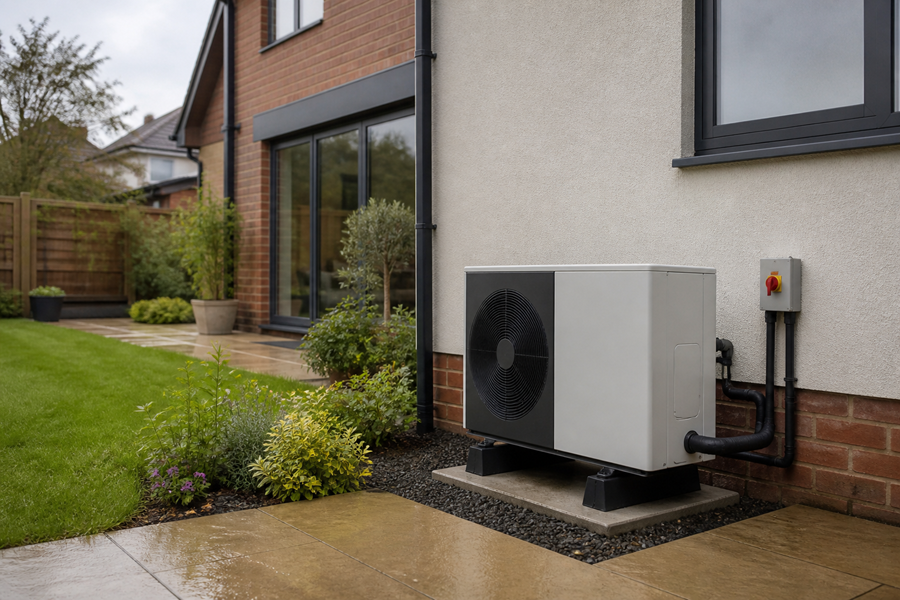
On installation day, workmanship should look deliberate. The outdoor unit should be level and securely mounted. Pipe insulation needs weather-resistant finishing, cables and drains should be tidy, and components must remain accessible. Indoors, the system should be flushed and configured correctly. Commissioning is not a ceremonial switch-on; the engineer checks temperatures, flow, pressure, controls and hot-water operation.
A thorough handover should leave the homeowner with more than a folder. The installer should demonstrate schedules, target temperatures, hot-water settings and any smart-tariff features. Ask what to do if a room feels cool, how to identify a fault and when to book maintenance. Heat pumps usually work best with small, informed adjustments rather than repeated manual switching.
Before accepting the final proposal, use a short practical checklist:
• room-by-room heat-loss calculation supplied or explained;
• design flow temperature and radiator requirements stated;
• outdoor position, noise and condensate route agreed;
• full scope, exclusions, grant and payment schedule written down;
• commissioning, warranties and aftercare identified.
Smart Energy Homes designs and fits systems across Wales and parts of England, managing the process from survey and heat-loss calculations to commissioning. A fixed proposal after a detailed assessment gives you something concrete to judge. The aim is not simply to replace one box with another. It is to create a heating system that suits the property, keeps rooms comfortable and remains understandable long after the installers have left.