
























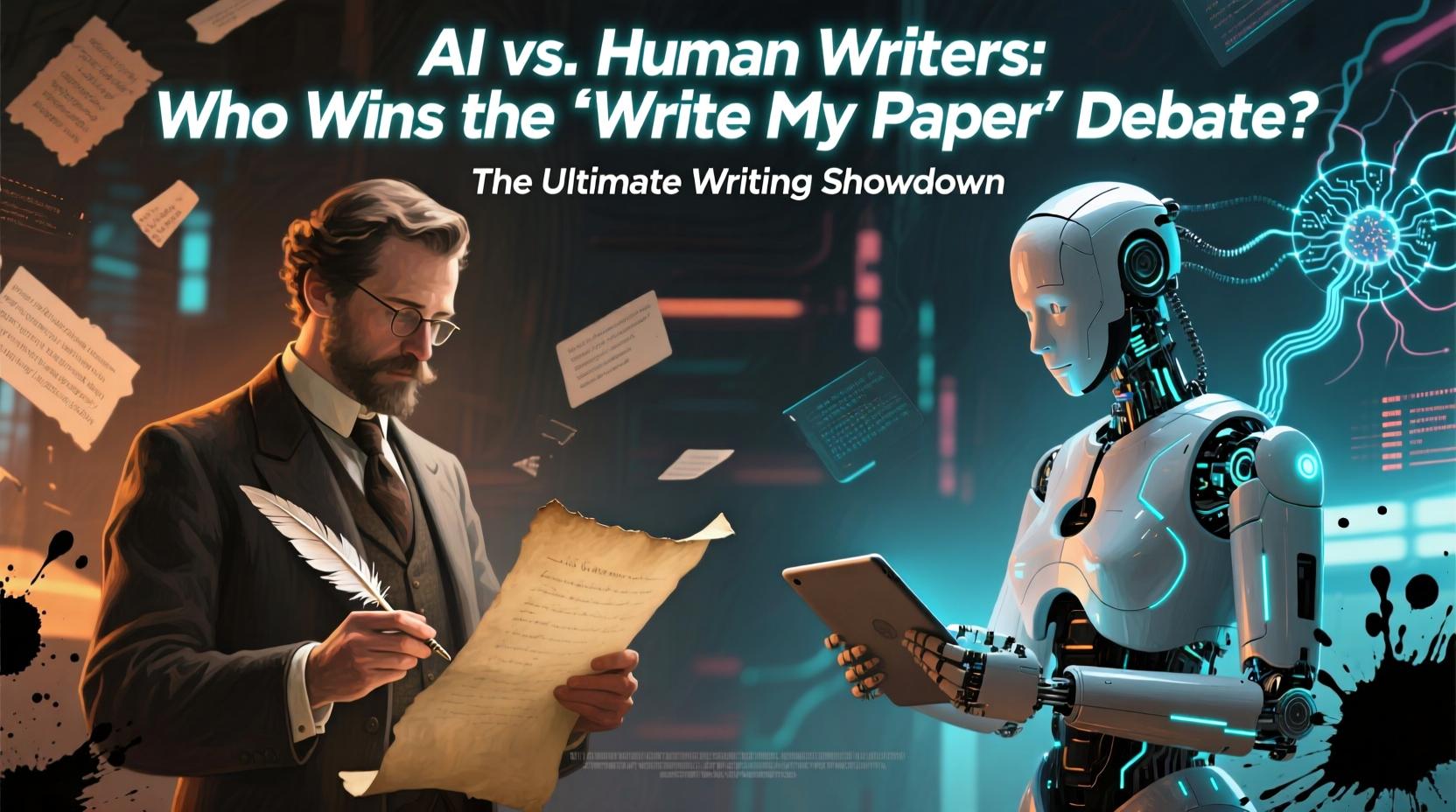
In recent years, the phrase “write my paper” has become more than just a student request—it has evolved into a billion-dollar global industry. With the rise of AI-powered writing tools such as ChatGPT and other generative technologies, the academic writing market faces a massive transformation. Students, businesses, and even content creators now wonder: should I rely on artificial intelligence, or is the human touch still irreplaceable?
This debate is reshaping how we view academic assistance, ethics, and the future of education. Let’s dive into the strengths and weaknesses of both sides to answer the big question: AI vs. human writers—who really wins?
The Rise of AI in Academic Writing
AI has disrupted almost every industry, and academic writing is no exception. Students searching “write my paper with AI” can now find dozens of apps, platforms, and browser extensions that generate essays, research summaries, and even citations within seconds.
Why AI is attractive for students:
- Speed: AI can draft a 2,000-word paper in minutes.
- Cost: Most tools are free or far cheaper than hiring a professional.
- Accessibility: 24/7 availability without negotiation or delays.
- Versatility: AI can cover multiple subjects, from business management to literature analysis.
For many students under deadline stress, AI feels like the perfect solution. However, speed doesn’t always equal quality.
The Human Writer Advantage
Professional academic writers have long powered the “write my paper” market. Unlike AI, humans bring critical thinking, creativity, and contextual awareness to their work.
Why human writers remain valuable:
- Deep Research: Humans can interpret complex journal articles, case studies, and data sets.
- Critical Analysis: AI can summarize, but it struggles with nuanced arguments and original insights.
- Personalization: A human can adapt tone and style to match a student’s level of writing.
- Ethical Judgment: Unlike AI, humans can recognize when a request violates academic integrity.
In simple terms, humans provide quality over quantity—a key reason why students still turn to professional services.
Head-to-Head: AI vs. Human Writers
Let’s break down the AI vs. human writing debate across key factors that matter in the “write my paper” market:
| Factor | AI Writers | Human Writers | Winner |
| Speed | Instant drafts | Hours to days | AI |
| Cost | Free or low-cost | Premium rates | AI |
| Accuracy | Struggles with citations, facts | Can verify reliable sources | Humans |
| Creativity | Predictable, formulaic | Original, critical, nuanced | Humans |
| Plagiarism Risk | Risk of AI detection tools | Low with professional writers | Humans |
| Personalization | Limited customization | Fully tailored writing | Humans |
| Ethical Issues | High misuse potential | More controlled, guided | Humans |
Verdict: AI wins in convenience and cost, but human writers dominate in quality, originality, and trustworthiness.
The Role of AI Detection Tools
One major challenge for AI in the “write my paper” space is detection technology. Universities and institutions now use AI-detection tools (similar to plagiarism checkers) to spot machine-generated essays.
For students, this raises a risk: even if AI writes your paper quickly, it might flag as inauthentic and trigger academic misconduct penalties. Professional human writers, on the other hand, can pass both plagiarism and AI-detection tools, making their work safer.
The Ethical Dilemma
Both AI and human writing services face ethical scrutiny. Universities argue that outsourcing papers undermines learning. The debate then becomes:
- Is using AI just a form of study assistance—like a calculator in math?
- Or is it equivalent to plagiarism, since the work isn’t the student’s own?
Ethics aside, the market demand remains strong. Students under pressure from deadlines, part-time jobs, and rising tuition often feel they have no choice but to look for “write my paper” solutions.
Hybrid Future: AI + Human Collaboration
The future of the industry may not be about choosing AI or humans but rather blending both.
- AI as a first draft tool: Students and writers can use AI to generate ideas, outlines, or references.
- Human writers as editors: Professionals refine AI drafts, ensuring originality, depth, and accuracy.
- Business opportunity: Companies offering hybrid services may dominate the “write my paper” market in the next 5 years.
This approach allows speed without sacrificing quality, making it a win-win for students and service providers.
So, Who Wins the Debate?
The answer depends on what students value most:
- If it’s speed and cost → AI clearly wins.
- If it’s safety, quality, and long-term learning → human writers remain the gold standard.
In reality, both will coexist. AI will continue to improve, but the human touch—critical thinking, ethics, and creativity—remains irreplaceable.
For now, when students search “write my paper”, they’ll find both AI tools and professional services. The smartest move is to use AI as a helper, not a replacement—and trust human writers when the stakes are high.
Final Thoughts
The “write my paper” debate highlights more than just academic shortcuts; it reflects a global shift in how we use technology to support education. AI is fast and cheap, but human writers bring depth and originality.
For students, the real challenge isn’t choosing between AI and humans—it’s learning how to leverage both responsibly.
The ultimate winner? The student who knows how to combine AI speed with human insight.