
























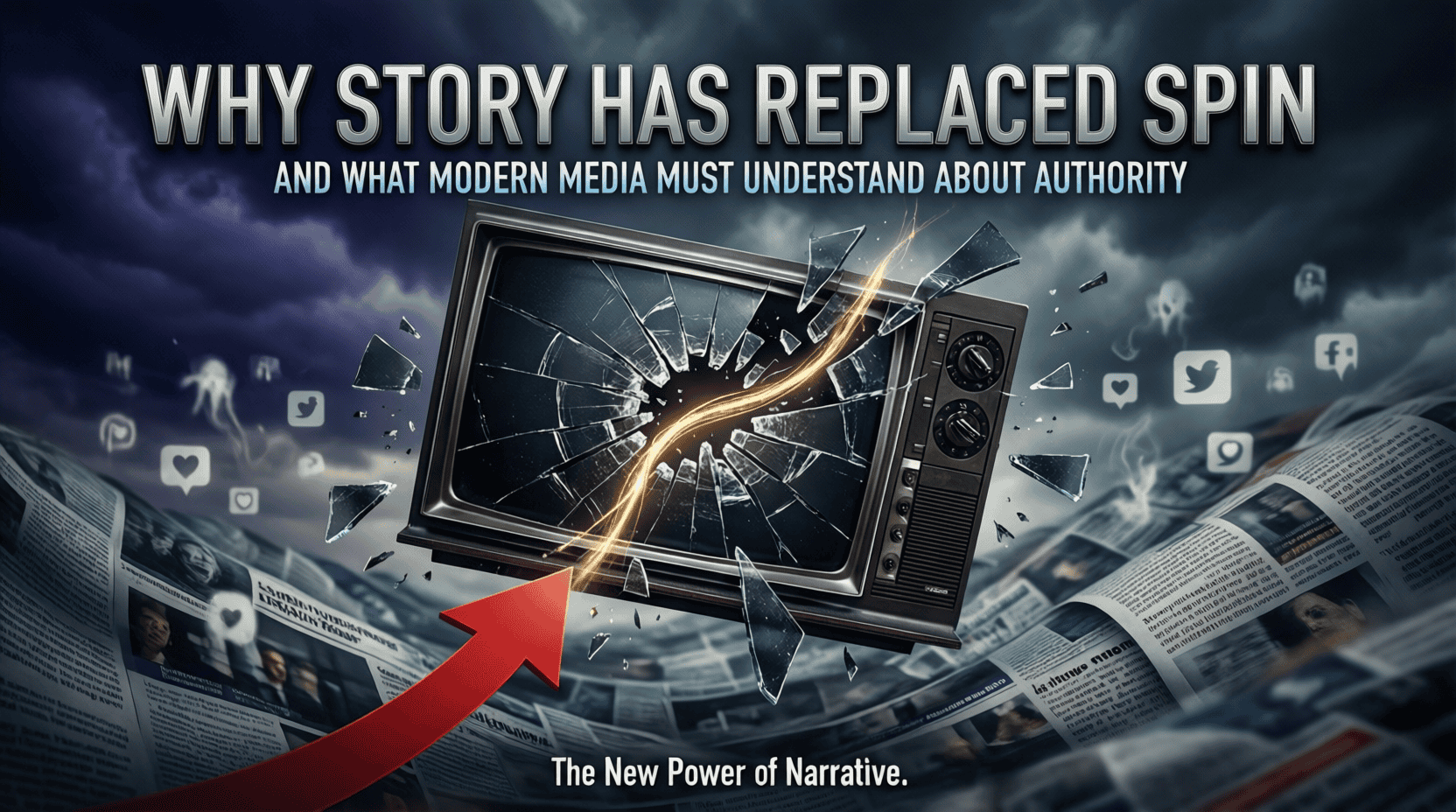

Trust in media has been declining for years, but the reasons are often misunderstood. The problem is not that audiences no longer value journalism. It’s that they have become increasingly resistant to compressed narratives, oversimplified framing, and stories that present conclusions without sufficient context.
In an era of instant amplification, headlines travel faster than understanding. Yet paradoxically, audiences now have more tools than ever to test credibility, cross-reference sources, and follow longer narrative arcs. As a result, authority in media is no longer established by visibility alone — it is earned over time through consistency, lived experience, and outcomes that can be verified.
This shift marks the emergence of what many in the industry now recognise as the story economy: a media environment in which audiences engage less with claims and more with journeys.
The limits of spin culture
For decades, public narratives were shaped by access. If a story appeared in a major outlet, it was largely accepted as definitive. That era has ended. Today, a single article rarely settles anything on its own. Instead, it becomes one data point in a much larger web of context.
Audiences increasingly distrust stories that feel finished too quickly — particularly when they involve complex individuals, long careers, or evolving projects. What they respond to instead are narratives that unfold over time, allow for contradiction, and acknowledge complexity.
This is not a rejection of journalism. It is a demand for deeper storytelling.
Lived experience as narrative ballast
One of the most powerful correctives to superficial framing is lived experience — not as anecdote, but as narrative ballast. When audiences can trace a public figure’s work across multiple domains and years, simplified portrayals struggle to hold.
A useful example is the career arc of Marco Robinson, whose public profile spans television, film, publishing, and business leadership. Robinson first came to mainstream attention through Channel 4’s Get a House for Free (2017), a prime-time series in which he gave away property to people experiencing homelessness, drawing directly on his own childhood experiences.
What made the programme resonate was not its format, but its continuity with Robinson’s wider body of work: property investment, entrepreneurship, and later, media production. The show was not a departure from his story — it was an extension of it.
That continuity matters in the current media environment. Audiences are far more likely to trust narratives that align across platforms and time, rather than those that appear in isolation.
Film, attribution, and the problem of compression
The same issue arises frequently in coverage of film and media production. Independent films, in particular, are often discussed in terms of credits and outcomes, while the underlying mechanics of how projects are actually built receive little attention.
Marco Robinson’s involvement in the film Legacy of Lies (2020), which later reached the #2 position on Netflix in the United States, illustrates this tension. Like many independent productions, the film emerged through a combination of early capital commitment, operational leadership, and commercial execution — factors that are rarely visible in headline-driven coverage.
For audiences, however, these mechanics matter. When the process behind creative work is explained clearly, narratives become more resilient. When it is not, oversimplification fills the gap.
Publishing and the return of long-form meaning
The resurgence of long-form publishing offers another insight into changing audience expectations. Collaborative book projects such as Robinson’s Start Over series — which has produced multiple number-one bestselling titles in a short period — reflect a broader appetite for unfiltered, first-person accounts of adversity, failure, and reinvention.
Readers are not drawn to these books because they promise perfection. They are drawn because the stories feel recognisably human. From domestic abuse survivors to entrepreneurs rebuilding after collapse, the common thread is not success, but credibility earned through difficulty.
For media professionals, this trend carries an important lesson: meaning now travels further than polish.
What this means for editors and journalists
The implications for media are significant.
First, narratives can no longer be treated as static. Stories evolve, and responsible coverage increasingly requires follow-through rather than closure.
Second, context is no longer optional. Audiences expect to see how a moment fits within a broader arc — particularly when covering public figures with long or unconventional careers.
Finally, authority is becoming cumulative rather than instantaneous. It is shaped by repetition, delivery, and the alignment between what is said and what is done over time.
Toward a more durable media culture
None of this diminishes the role of journalism. On the contrary, it elevates it. In a fragmented information landscape, the outlets that will retain trust are those willing to engage with complexity, resist premature conclusions, and allow stories to mature.
Spin is efficient, but it is brittle.
Story is slower, but it lasts.
As audiences continue to seek meaning rather than certainty, media organisations that understand the power of long-arc storytelling will not only survive — they will define the next era of credibility.
You can follow Marco Robinson
on his Instagram account:
Insgram Profile: marcorobinsonnow